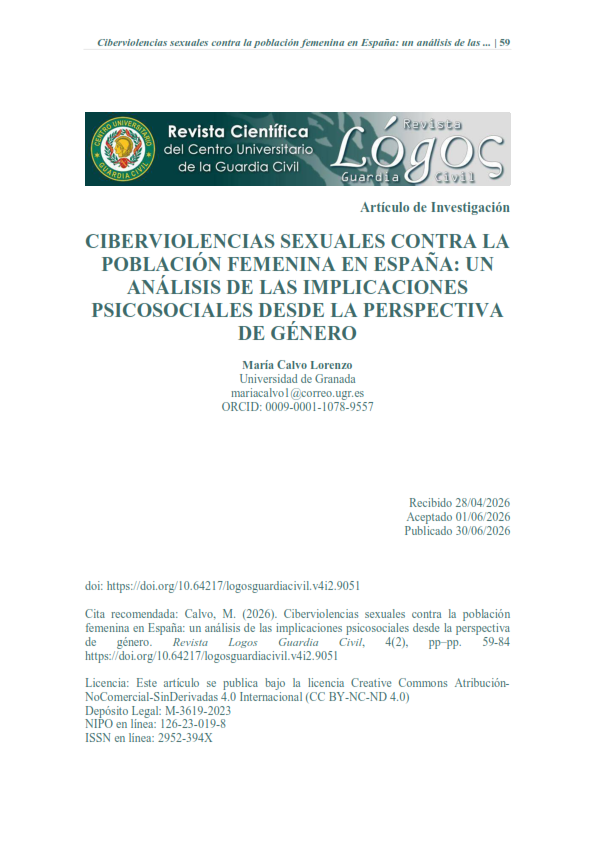
Ciberviolencias sexuales contra la población femenina en España: un análisis de las implicaciones psicosociales desde la perspectiva de género
DOI:
https://doi.org/10.64217/logosguardiacivil.v4i2.9051Palabras clave:
ciberseguridad, sextorsión, acoso sexual digital, plataformas digitales, igualdad de géneroResumen
Con el fin de analizar las ciberviolencias sexuales contra la población femenina en España desde una perspectiva psicosocial y de género, se realizó una revisión narrativa de la literatura identificando 438 documentos de los cuales 48 cumplieron los criterios de inclusión. Las ciberviolencias sexuales constituyen un fenómeno creciente que afecta desproporcionadamente a las mujeres, evidenciando cómo las tecnologías digitales amplifican las desigualdades estructurales de género; entre sus dimensiones destacan el acoso sexual digital, la sextorsión, el abuso sexual basado en imágenes o «porno de venganza», así como fenómenos emergentes como el blanqueamiento del negocio sexual en plataformas de contenido. Las consecuencias en salud mental documentadas incluyen ideación e intentos suicidas, ansiedad, depresión, trauma, estrés postraumático, problemas de sueño, baja autoestima y autoobjetificación. La inteligencia artificial ha emergido como una nueva herramienta de perpetración, facilitando la creación de deepfakes y aplicaciones de desnudo no consensuado. En el ámbito preventivo, la ciberseguridad ofrece herramientas tecnológicas, aunque las aplicaciones existentes presentan limitaciones significativas y las tasas de denuncia no superan el 7,3%. Se concluye que las ciberviolencias sexuales son una expresión amplificada de desigualdades de género, requiriendo intervenciones integrales que combinen educación con perspectiva de género, regulación de plataformas, formación profesional y diseño ético de tecnologías.
Descargas
Citas
Benítez-Hidalgo, V., Henares-Montiel, J., Ruiz-Pérez, I., y Pastor-Moreno, G. (2024). Cyber sexual harassment against women and impact on health. A cross-sectional study in a representative population sample. Journal of Public Health, 46(1), 3-11. https://doi.org/10.1093/pubmed/fdad182
Benítez-Hidalgo, V., Henares-Montiel, J., Ruiz-Pérez, I., y Pastor-Moreno, G. (2025). International Prevalence of Technology-Facilitated Sexual Violence Against Women: A Systematic Review and Meta-Analysis of Observational Studies. Trauma, Violence y Abuse, 26(4), 668-681. https://doi.org/10.1177/15248380241286813
Casanovas, L. V.-L., Serra, L., Canals, C. S., Sanz-Barbero, B., Vives-Cases, C., López, M. J., Otero-García, L., Pérez, G., y Renart-Vicens, G. (2022). Prevalence of sexual harassment among young Spaniards before, during, and after the COVID-19 lockdown period in Spain. BMC Public Health, 22(1), 1888. https://doi.org/10.1186/s12889-022-14264-9
Castellanos-Torres, E., Sanz-Barbero, B., Vives-Cases, C., y CIBER Program of Violence and Young People team. (2023). COVID-19 and sexual violence against women: A qualitative study about young people and professionals’ perspectives in Spain. PloS One, 18(8), e0289402. https://doi.org/10.1371/journal.pone.0289402
Champion, A. R., Oswald, F., Khera, D., y Pedersen, C. L. (2022). Examining the Gendered Impacts of Technology-Facilitated Sexual Violence: A Mixed Methods Approach. Archives of Sexual Behavior, 51(3), 1607-1624. https://doi.org/10.1007/s10508-021-02226-y
Colburn, D. A., Finkelhor, D., y Turner, H. A. (2023). Help-Seeking From Websites and Police in the Aftermath of Technology-Facilitated Victimization. Journal of Interpersonal Violence, 38(21-22), 11642-11665. https://doi.org/10.1177/08862605231186156
Colburn, D., Mitchell, K. J., Gewirtz-Meydan, A., Finkelhor, D., Turner, H. A., y O’Brien, J. E. (2025). Life impact following childhood Image-Based Sexual Abuse victimization among a sample of young adults. Child Abuse y Neglect, 167, 107584. https://doi.org/10.1016/j.chiabu.2025.107584
Comité para la Eliminación de la Discriminación contra la Mujer. (2017, 26 de julio). Recomendación general núm. 35 sobre la violencia por razón de género contra la mujer, por la que se actualiza la recomendación general núm. 19 (CEDAW/C/GC/35). ACNUR. https://www.acnur.org/fileadmin/Documentos/BDL/2017/11405.pd
Cunha-Oliveira, A., Camarneiro, A. P., Gómez-Cantarino, S., Cipriano-Crespo, C., Queirós, P. J. P., Cardoso, D., Santos, D. G., y Ugarte-Gurrutxaga, M. I. (2021). The Integration of Gender Perspective into Young People’s Sexuality Education in Spain and Portugal: Legislation and Educational Models. International Journal of Environmental Research and Public Health, 18(22), 11921. https://doi.org/10.3390/ijerph182211921
Döring, N., Le, T. D., y Miller, D. J. (2025). Experiences with AI-Generated Pornography: A Quantitative Content Analysis of Reddit Posts. Archives of Sexual Behavior. https://doi.org/10.1007/s10508-025-03227-x
Durán, M., y Rodríguez-Domínguez, C. (2023). Sending of Unwanted Dick Pics as a Modality of Sexual Cyber-Violence: An Exploratory Study of Its Emotional Impact and Reactions in Women. Journal of Interpersonal Violence, 38(5-6), 5236-5261. https://doi.org/10.1177/08862605221120906
European Institute for Gender Equality. (2024). Combating cyber violence against women and girls: Developing an EU measurement framework. Publications Office of the European Union. https://op.europa.eu/en/publication-detail/-/publication/4a0b01fc-e839-11ef-b5e9-01aa75ed71a1/language-en
Europol. (2025). Internet Organised Crime Threat Assessment (IOCTA) 2025: Steal, deal and repeat: How cybercriminals trade and exploit your data. Publications Office of the European Union, Luxembourg. https://www.europol.europa.eu/publication-events/main-reports/steal-deal-and-repeat-how-cybercriminals-trade-and-exploit-your-data
Fagan, P. (2024). Clicks and tricks: The dark art of online persuasion. Current Opinion in Psychology, 58, 101844. https://doi.org/10.1016/j.copsyc.2024.101844
Finkelhor, D., Walsh, K., Jones, L., Mitchell, K., y Collier, A. (2021). Youth Internet Safety Education: Aligning Programs With the Evidence Base. Trauma, Violence y Abuse, 22(5), 1233-1247. https://doi.org/10.1177/1524838020916257
Flynn, A., Powell, A., Eaton, A., y Scott, A. J. (2025). Sexualized Deepfake Abuse: Perpetrator and Victim Perspectives on the Motivations and Forms of Non-Consensually Created and Shared Sexualized Deepfake Imagery. Journal of Interpersonal Violence, 8862605251368834. https://doi.org/10.1177/08862605251368834
Fry, D., Krzeczkowska, A., Ren, J., Lu, M., Fang, X., y Into the Light Index Study Group. (2025). Prevalence estimates and nature of online child sexual exploitation and abuse: A systematic review and meta-analysis. The Lancet. Child y Adolescent Health, 9(3), 184-193. https://doi.org/10.1016/S2352-4642(24)00329-8
Fuentes, P. A., y Berger, T. C. (2025). Pornografía y sexualidad en OnlyFans: El rol de la subjetivación femenina. Persona y Sociedad, 39(1), 11-25. https://doi.org/10.53689/pys.v39i1.467
García Mingo, E., Lorca, J. G., y Ruíz Repullo, C. (2025). “La tecnología al servicio de la igualdad”: Agenda de investigación sobre violencia sexual digital en España. https://doi.org/10.5565/rev/athenea.3687
García-Vázquez, J., Ruiz-Azcona, L., Pellico-López, A., y Paz-Zulueta, M. (2024). Characteristics of emotional and sexuality education programs in the Spanish school population. Heliyon, 10(20), e39368. https://doi.org/10.1016/j.heliyon.2024.e39368
Harkin, D., y Merkel, R. (2023). Technology-Based Responses to Technology-Facilitated Domestic and Family Violence: An Overview of the Limits and Possibilities of Tech-Based «Solutions». Violence Against Women, 29(3-4), 648-670. https://doi.org/10.1177/10778012221088310
Hellevik, P. M., Haugen, L.-E. A., y Överlien, C. (2025). Outcomes of image-based sexual abuse among young people: A systematic review. Frontiers in Psychology, 16, 1599087. https://doi.org/10.3389/fpsyg.2025.1599087
Henry, N., y Beard, G. (2024). Image-Based Sexual Abuse Perpetration: A Scoping Review. Trauma, Violence y Abuse, 25(5), 3981-3998. https://doi.org/10.1177/15248380241266137
Henry, N., Flynn, A., y Powell, A. (2020). Technology-Facilitated Domestic and Sexual Violence: A Review. Violence Against Women, 26(15-16), 1828-1854. https://doi.org/10.1177/1077801219875821
Henry, N., y Flynn, A. (2019). Image-Based Sexual Abuse: Online Distribution Channels and Illicit Communities of Support. Violence Against Women, 25(16), 1932-1955. https://doi.org/10.1177/1077801219863881
Henry, N., y Powell, A. (2018). Technology-Facilitated Sexual Violence: A Literature Review of Empirical Research. Trauma, Violence y Abuse, 19(2), 195-208. https://doi.org/10.1177/1524838016650189
Iroegbu, M., O’Brien, F., Muñoz, L. C., y Parsons, G. (2024). Investigating the Psychological Impact of Cyber-Sexual Harassment. Journal of Interpersonal Violence, 39(15-16), 3424-3445. https://doi.org/10.1177/08862605241231615
Karasavva, V. (2025). The Frequency, Nature, Impact, and Coping Strategies of Nonconsensual Intimate Image Dissemination Victimization: A Scoping Review. Trauma, Violence y Abuse, 15248380251383940. https://doi.org/10.1177/15248380251383940
Karasavva, V., y Noorbhai, A. (2021). The Real Threat of Deepfake Pornography: A Review of Canadian Policy. Cyberpsychology, Behavior and Social Networking, 24(3), 203-209. https://doi.org/10.1089/cyber.2020.0272
Latcheva, R. (2017). Sexual Harassment in the European Union: A Pervasive but Still Hidden Form of Gender-Based Violence. Journal of Interpersonal Violence, 32(12), 1821-1852. https://doi.org/10.1177/0886260517698948
Lazard, L., Capdevila, R., Turley, E. L., Gilfoyle, K., y Stavropoulou, N. (2025). Deepfake Technology and Gender-Based Violence: A Scoping Review. Trauma, Violence y Abuse, 15248380251384271. https://doi.org/10.1177/15248380251384271
López-Barranco, P.J.; López-Yepes, S.; Conesa-Ferrer, M.B.; Cayuela-Fuentes, P.S.; Beladiez-Pérez, M.d.M.; Jiménez-Ruiz, I. Violence Against Women on Social Networks: A Descriptive Analysis. Healthcare 2025, 13, 2574. http://hdl.handle.net/10201/170129
Lorca, J. G. (2024). La reparación del daño en mujeres afectadas por prácticas de abuso sexual basado en imágenes en España. Tendencias Sociales. Revista de Sociología, 2(10). https://doi.org/10.5944/ts.2023.43124
Mania, K. (2024). Legal Protection of Revenge and Deepfake Porn Victims in the European Union: Findings From a Comparative Legal Study. Trauma, Violence y Abuse, 25(1), 117-129. https://doi.org/10.1177/15248380221143772
Mármol, C. J., Luna, A., y Legaz, I. (2025). Disproportionate Cybersexual Victimization of Women from Adolescence into Midlife in Spain: Implications for Targeted Protection and Prevention. Behavioral Sciences, 15(11), 1571. https://doi.org/10.3390/bs15111571
Martínez Bacaicoa, J. (2024). Technology-facilitated sexual and gender-based violence: Measurement, moral disengagement, and factors related to perpetration and victimization (p. 1). https://dialnet.unirioja.es/servlet/tesis?codigo=362106
Martínez-Bacaicoa, J., Henry, N., Mateos-Pérez, E., y Gámez-Guadix, M. (2024). Online Gendered Violence Victimization Among Adults: Prevalence, Predictors and Psychological Outcomes. Psicothema, 36(3), 247-256. https://doi.org/10.7334/psicothema2023.315
Martínez Román, R., Lameiras Fernández, M., Adá Lameiras, A., y Rodríguez Castro, Y. (2026). Analysis of Image-Based Sexual Harassment and Abuse in Adolescents’ Socio-Affective Relationships. Journal of Interpersonal Violence, 41(3-4), 816-840. https://doi.org/10.1177/08862605251315767
Mayuri-Bocanegra, E., y Aliaga-Pacora, A. A. (2023). La regulación de la trata de personas para fines de explotación laboral y la captación de víctimas mediante redes sociales de Lima. Ciencia Latina Revista Científica Multidisciplinar, 7(3), 452-471. https://doi.org/10.37811/cl_rcm.v7i3.6206
Medina-Bravo, P. (2021). Empoderamiento femenino: La trampa de un feminismo domesticado. Discurso y Sociedad, 15(3), 588-600. https://doi.org/10.14198/dissoc.15.3.4
Ministerio de Igualdad. (2025). Macroencuesta de Violencia contra la Mujer 2024. Delegación del Gobierno contra la Violencia de Género. https://violenciagenero.igualdad.gob.es/violenciaencifras/macroencuesta-de-violencia-contra-la-mujer-2024/
Morgan, C. H., Stager, L. M., Brockdorf, A. N., Salamanca, N. K., Amaya, S., Mujica, C. A., Davis, K. C., Leone, R., Orchowski, L. M., Gilmore, A. K., y López, C. (2025). Sleep-Related Concerns Mediate the Association Between Cyber-Sexual Victimization and Psychological Distress Among Diverse University Students. Cyberpsychology, Behavior and Social Networking, 28(10), 689-697. https://doi.org/10.1177/21522715251375417
Munzer, T., Parga-Belinkie, J., Milkovich, L. M., Tomopoulos, S., Ajumobi, T., Cross, C., Gerwin, R., Madigan, S., Psych, R., y Council on Communications and Media. (2026). Digital Ecosystems, Children, and Adolescents: Policy Statement. Pediatrics, 157(2), e2025075320. https://doi.org/10.1542/peds.2025-075320
ONU Mujeres. (2024). Violencia contra las mujeres y las niñas facilitada por la tecnología: una amenaza en rápida evolución. En Intensificación de los esfuerzos para eliminar todas las formas de violencia contra las mujeres y las niñas: Informe del Secretario General (A/79/500). ONU Mujeres. https://www.unwomen.org/es/digital-library/publications/2024/10/intensificacion-de-los-esfuerzos-para-eliminar-todas-las-formas-de-violencia-contra-las-mujeres-y-las-ninas-informe-del-secretario-general-2024
Pastor-Moreno, G., Ruiz-Pérez, I., Sordo, L., y Henares-Montiel, J. (2022). Frequency, Types, and Manifestations of Partner Sexual Violence, Non-Partner Sexual Violence and Sexual Harassment: A Population Study in Spain. International Journal of Environmental Research and Public Health, 19(13), 8108. https://doi.org/10.3390/ijerph19138108
Parlamento Europeo y Consejo de la Unión Europea. (2024, 13 de junio). Reglamento (UE) 2024/1689 por el que se establecen normas armonizadas en materia de inteligencia artificial (Reglamento de Inteligencia Artificial). Diario Oficial de la Unión Europea, L 2024/1689. https://eur-lex.europa.eu/legal-content/ES/TXT/?uri=CELEX:32024R1689
Parlamento Europeo y Consejo de la Unión Europea. (2022, 19 de octubre). Reglamento (UE) 2022/2065 relativo a un mercado único de servicios digitales y por el que se modifica la Directiva 2000/31/CE (Reglamento de Servicios Digitales). Diario Oficial de la Unión Europea, L 277, 1–102. https://eur-lex.europa.eu/legal-content/ES/TXT/?uri=CELEX:32022R2065
Ray, A., y Henry, N. (2025). Sextortion: A Scoping Review. Trauma, Violence y Abuse, 26(1), 138-155. https://doi.org/10.1177/15248380241277271
Rodríguez-Castro, Y., Martínez-Román, R., Alonso-Ruido, P., Adá-Lameiras, A., y Carrera-Fernández, M. V. (2021). Intimate Partner Cyberstalking, Sexism, Pornography, and Sexting in Adolescents: New Challenges for Sex Education. International Journal of Environmental Research and Public Health, 18(4), 2181. https://doi.org/10.3390/ijerph18042181
Salerno-Ferraro, A. C., Erentzen, C., y Schuller, R. A. (2022). Young Women’s Experiences With Technology-Facilitated Sexual Violence From Male Strangers. Journal of Interpersonal Violence, 37(19-20), NP17860-NP17885. https://doi.org/10.1177/08862605211030018
Shirzad, M., Ramaiya, A., Edwards, K., Yuan, M., Bhanot, S., y Kaufman, M. R. (2025). Using safe and ethical technology to prevent and respond to sexual and interpersonal violence during adolescence and young adulthood: Identifying evidence, best practices, and pathways forward-A global scoping review protocol. PloS One, 20(8), e0320709. https://doi.org/10.1371/journal.pone.0320709
Sumra, M., Asghar, S., Khan, K. S., Fernández-Luna, J. M., Huete, J. F., y Bueno-Cavanillas, A. (2023). Smartphone Apps for Domestic Violence Prevention: A Systematic Review. International Journal of Environmental Research and Public Health, 20(7), 5246. https://doi.org/10.3390/ijerph20075246
Tribunal Europeo de Derechos Humanos. (2020, 11 de febrero). Buturugă c. Rumanía (Demanda núm. 56867/15). https://hudoc.echr.coe.int/eng?i=001-201342
Tribunal Europeo de Derechos Humanos. (2019). Volodina c. Rusia, Demanda núm. 41261/17, sentencia de 9 de julio de 2019. Consejo de Europa. https://www.cepc.gob.es/sites/default/files/2021-12/sentencia-volodina-v-rusia.pdf
Vizcaíno-Cuenca, R., Carretero-Dios, H., y Romero-Sánchez, M. (2026). «It’s Not Violence, It’s an Exaggerated Complaint»: The Role of Cyber-Rape Culture and Objectification Theory in Understanding the Emotional Impact in Women That Have Experienced Cyber-Sexual Violence. Journal of Sex Research, 63(2), 270-283. https://doi.org/10.1080/00224499.2025.2592624
Williams, K. (2025). «There Are No Limits!»: AI Undressing Apps and the Normalization of Nonconsensual Intimate Deepfakes. Violence Against Women, 10778012251397966. https://doi.org/10.1177/10778012251397966
Publicado
Cómo citar
Número
Sección
Licencia
Derechos de autor 2026 Lydia Comerón Manzano, María Calvo Lorenzo

Esta obra está bajo una licencia internacional Creative Commons Atribución-NoComercial-SinDerivadas 4.0.
-
Atribución — Usted debe dar crédito de manera adecuada, brindar un enlace a la licencia, e indicar si se han realizado cambios. Puede hacerlo en cualquier forma razonable, pero no de forma tal que sugiera que usted o su uso tienen el apoyo de la licenciante.
-
NoComercial — Usted no puede hacer uso del material con propósitos comerciales.
-
SinDerivadas — Si remezcla, transforma o crea a partir del material, no podrá distribuir el material modificado.
- No hay restricciones adicionales — No puede aplicar términos legales ni medidas tecnológicas que restrinjan legalmente a otras a hacer cualquier uso permitido por la licencia.