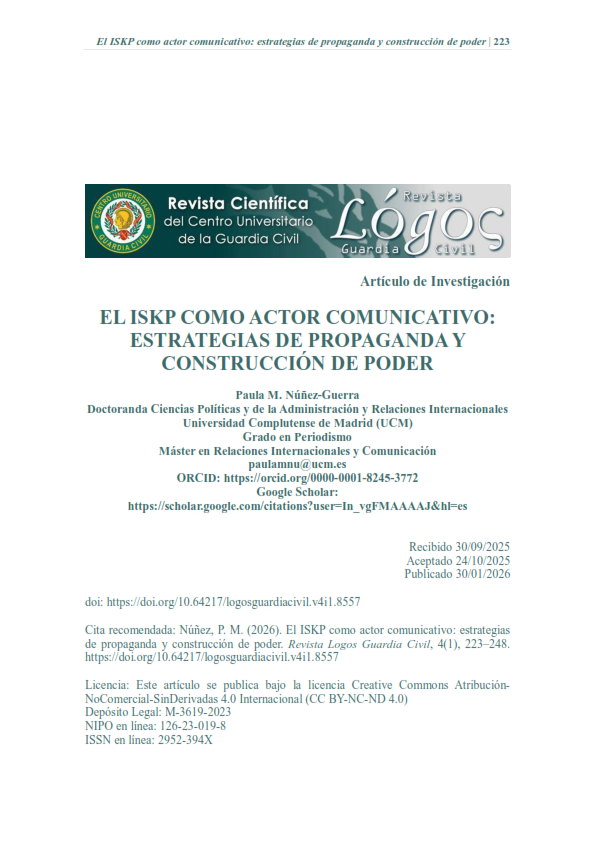
The ISKP as a communicative actor: propaganda strategies and power construction
DOI:
https://doi.org/10.64217/logosguardiacivil.v4i1.8557Keywords:
Terrorism, ISKP, Al Azaim, International RelationsAbstract
The Islamic State of Khorasan Province (ISKP) has emerged as a key communications actor within the global jihadist ecosystem, using propaganda as a strategic tool to expand its influence and consolidate its power. Since the return of the Taliban in Afghanistan in 2021, the ISKP has intensified, as a Da’esh subsidiary, its regionalization and internationalization strategy, extending its reach beyond Central and South Asia to the West. This expansion has been reflected in a sophisticated media network, which includes its reference platform Al Azaim. In this article, and within the framework of a research stay at the Centre for Intelligence against Terrorism and Organised Crime (CITCO), it will analyse one of Da’esh’s most important magazines, which is generally published in English: Voice of Khurasan magazine, as well as the recent Light of Darkness newsletters that emerged from it. The purpose of all this is to compare the thematic content of the seven issues published so far, as well as to draw parallels with the producer’s own broadcasts in those months. Consequently, and under the premise that these media have a different focus, the question will be answered: What communicative strategies does the ISKP use to position itself as a relevant actor within the global jihadist panorama? This will be done using a methodology based on a descriptive method, an observation method and a comparative method.
Downloads
References
Ahmazada, S. H. W. (comunicación personal, 3 de septiembre de 2025)
Beradze, D. (2022). Islamic State Khorasan Province (ISKP) – threats to the regional security environment and challenges for the taliban. Free University Journal of Asian Studies, 1-6. https://bitly.cx/D5N6
Calduch, R. (2011). La incidencia de los atentados del 11 de septiembre en el terrorismo internacional. Revista Española de Derecho Internacional, 53(1/2), 173-203, https://bitly.cx/JOuX
Calvillo, J. M. (2023). Los Talibán 2.0. Del terrorismo al contraterrorismo. Studia Historica. Historia Contemporánea, 41, 15-37. https://doi.org/10.14201/shhc2023411537
Centro Memorial de las Víctimas del Terrorismo (2025). Balance del terrorismo en España 2024. Centro Memorial de las Víctimas del Terrorismo, 15, 55-61. https://bitly.cx/kz5LC
Cutrale, E. (2019). El terrorismo yihadista. Universitas, 30, 88-118. https://doi.org/10.20318/universitas.2019.4837
Dabiq (2014). Dabiq nº 2.
De la Corte, L. (2013). ¿Hasta qué punto convergen el terrorismo global y la criminalidad organizada?: Parámetros generales y escenarios críticos. Revista del Instituto Español de Estudios Estratégicos, 1, 1-28. http://hdl.handle.net/10486/665660
DSN (2025). Índice del Terrorismo Global 2025. Departamento de Seguridad Nacional. Recuperado el 29 de agosto de 2025 de https://bitly.cx/jkq6h
Europol (2025). European Union Terrorism Situation and Trend Report 2025 (EU TE-SAT), Publications Office of the European Union, Luxembourg. https://bitly.cx/U3DBN
Fernández, G. (2022). Revisión crítica de los delitos contra-discursivos en España a la luz de un concepto de terrorismo materialmente fundamentado. Revista Penal México, 21, 141-166. https://bitly.cx/cuSzh
Gazapo, M. J. (comunicación personal, 2 de septiembre de 2025)
Hodge, E. (2019). Disensos e imprecisiones del concepto “terrorismo”: cuestionamientos a los enfoques teóricos tradicionales. Revista de Relaciones Internacionales, Estrategia y Seguridad, 14(1), 223-236. https://doi.org/10.18359/ries.3707
Jadoon, A. et al. (2024). From Tajikistan to Moscow and Iran: Mapping the Local and Transnational Threat of Islamic State Khorasan. Combating Terrorism Center at West Point, 17(5), 1-12. https://bitly.cx/NoxZ8
Minniti, F. (2025). Automated Recruitment: Artificial Intelligence, ISKP, and Extremist Radicalisation. Global Network on Extremism and Technology. https://bitly.cx/vpvQr
Montes, D. (2021). A vueltas con el terrorismo e internet: hacia una definición de ciberterrorismo. Revista de Derecho UNED, (27), 697-738. https://bitly.cx/jtk5
SATP (2025) Afganistan – Terrorist, insurgent and extremist groups. South Asia Terrorism Portal. Recuperado el 23 de septiembre de 2025 de https://satp.org/terrorist-groups/afghansitan
Setas, C. (2015). ¿El Estado Islámico en Pakistán? Revista del Instituto Español de Estudios Estratégicos, 66, 1-12. https://bitly.cx/KnAI
Soliev. N. (2023). The Digital Terror Financing of Central Asian Jihadis. Combating Terrorism Center at West Point, 16(4), 20-27. https://bitly.cx/lIYqC
Voice of Khurasan (enero 2025). Voice of Khurasan nº 43.
Voice of Khurasan (julio 2023). Voice of Khurasan nº 27.
Voice of Khurasan (junio 2025). Voice of Khurasan nº 46.
Voice of Khurasan (marzo 2024). Voice of Khurasan nº 34.
Voice of Khurasan (marzo 2025). Voice of Khurasan nº 45.
Voice of Khurasan (mayo 2024). Voice of Khurasan nº 36.
Voice of Khurasan (septiembre 2024). Voice of Khurasan nº 39.
Vox-Pol Institute (2025). Briefing Mayo 2025.
Weiss, C. y Webber, L. (2024). Islamic State-Somalia: A Growing Global Terror Concern. Combating Terrorism Center at West Point, 17(8), 12-21. https://bitly.cx/p0B9
Zelin, A. (2013). The State of Global Jihad Online. A Qualitative, Quantitative, and Cross-Lingual Analysis. New America Foundation, 1-24. https://bitly.cx/ui4RB
Downloads
Published
How to Cite
Issue
Section
License
Copyright (c) 2025 Paula M. Núñez-Guerra

This work is licensed under a Creative Commons Attribution-NonCommercial-NoDerivatives 4.0 International License.
-
Attribution — You must give appropriate credit, provide a link to the license, and indicate if changes were made. You may do so in any reasonable manner, but not in any way that suggests the licensor endorses you or your use.
-
NonCommercial — You may not use the material for commercial purposes.
-
NoDerivatives — If you remix, transform, or build upon the material, you may not distribute the modified material.
- No additional restrictions — You may not apply legal terms or technological measures that legally restrict others from doing anything the license permits.