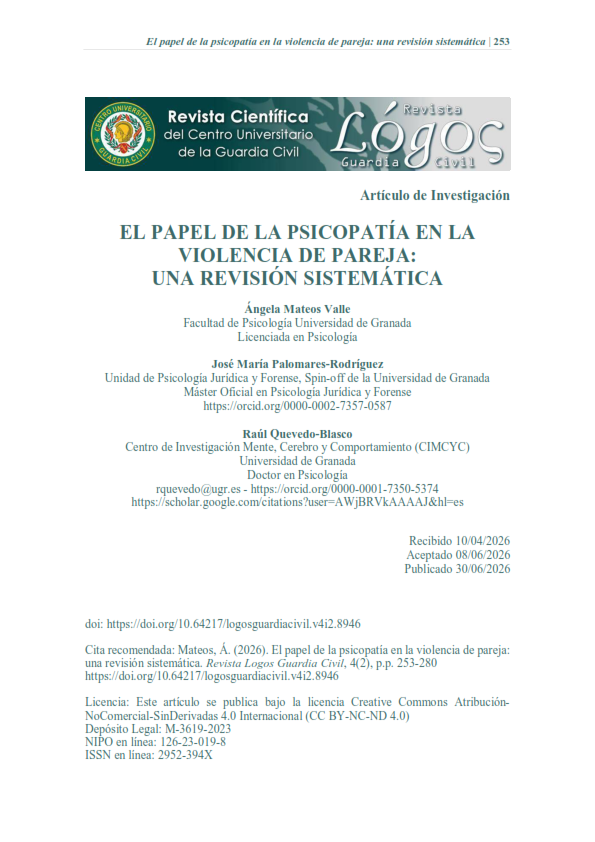
The role of psychopathy in intimate partner violence: a systematic review
DOI:
https://doi.org/10.64217/logosguardiacivil.v4i2.8946Keywords:
psychopathological disorders, intimate partner violence, psychopathic dimensions, recidivism, systematic review, psychopathological disorders, intimate partner violence, psychopathic dimensions, recidivism, systematic reviewAbstract
Intimate partner violence (IPV) constitutes a public health problem with serious physical, psychological, and social consequences. Among the individual factors associated with its perpetration, psychopathy has gained particular relevance in recent years. The present study aims to update and analyze the empirical evidence published between 2017 and 2025 on the relationship between psychopathic traits and intimate partner violence. A systematic review was conducted following the PRISMA guidelines. The search was conducted in the Scopus, Web of Science databases and on the ProQuest platform, applying pre-defined PICOS criteria. Twenty quantitative studies were included, comprising a total sample of 7,706 adults from clinical, community, and forensic settings. The results show a significant association between psychopathy and IPV, especially when the dimensions of the construct are analyzed separately. Primary psychopathy is mainly linked to instrumental violence and control strategies, while secondary psychopathy is associated with impulsive violence and a higher risk of recidivism. Likewise, differentiated profiles of aggressors are identified based on the predominant psychopathic facets. The clinical and forensic implications derived from these findings are discussed, as well as the methodological limitations of the current literature. Overall, the results support the importance of the dimensional analysis of psychopathy to understand the heterogeneity of IPV.
Downloads
References
Ali, P. A., Dhingra, K., y McGarry, J. (2016). A literature review of intimate partner violence and its classifications. Aggression Violent Behavior, 31, 16-25. https://doi.org/10.1016/j.avb.2016.06.008
Armenti, N. A., y Babcock, J. C. (2018). Psychophysiological reactivity profiles of partner-violent men with borderline or psychopathic personality features: The role of empathy. International Journal of Offender Therapy and Comparative Criminology, 62(11), 3337–3354. https://doi.org/10.1177/0306624X17740029
Arrojo, S., Martín-Fernández, M., Lila, M., Conchell, R., y Gracia, E. (2024). The perceived severity of adolescent dating violence (PS-ADV) scale: A validation study. European Journal of Psychology Applied to Legal Context, 16(1), 27-36. https://doi.org/10.5093/ejpalc2024a3
Babcock, J. C., y Michonski, J. D. (2019). Sensitivity to facial affect in partner-violent men: The role of psychopathic and borderline traits. Journal of Aggression Conflict and Peace Research, 11(3), 213–224. https://doi.org/10.1108/JACPR-12-2018-0396
Brassard, A., Gagnon, C., Claing, A., Dugal, C., Savard, C., y Péloquin, K. (2022). Can romantic attachment and psychopathy concomitantly explain the forms and severity of perpetrated intimate partner violence in men seeking treatment? Partner Abuse, 13(1), 123–142. https://doi.org/10.1891/PA-2021-0008
Brazil, K. J., Vance, G., Zeigler-Hill, V., Y Shackelford, T. K. (2023). Men’s psychopathy and mating effort in intimate relationships: Links with jealousy and sexual coercion. Archives of Sexual Behavior, 52(6), 2421–2432. https://doi.org/10.1007/s10508-023-02587-6
Breiding, M., Basile, K. C., Smith, S. G., Black, M. C., y Mahendra, R. R. (2015). Intimate partner violence surveillance: Uniform definitions and recommended data elements. Version 2.0. National Center for Injury Prevention and Control, Centers for Disease Control and Prevention. https://stacks.cdc.gov/view/cdc/31292
Brzozowski, A., Gillespie, S. M., Dixon, L., y Mitchell, I. J. (2021). Cardiac autonomic function and psychological characteristics of heterosexual female perpetrators of intimate partner physical aggression. Journal of Interpersonal Violence, 36(7–8), 3638–3661. https://doi.org/10.1177/0886260518775748
Burghart, M. y Mier, D. (2022). No feelings for me, no feelings for you: A meta-analysis on alexithymia and empathy in psychopathy. Personality and Individual Differences, 194, 111658. https://doi.org/10.1016/j.paid.2022.111658
Centers for Disease Control and Prevention. (2024, mayo 16). About intimate partner violence. https://www.cdc.gov/intimate-partner-violence/about/index.htmlCDC
Collison, K. L. y Lynam, D. R. (2023). Personality traits, personality disorders, and aggression: A comparison of intimate partner violence and non-intimate-partner aggression. Journal of Psychopathology and Behavioral Assessment, 45(2), 294–307. https://doi.org/10.1007/s10862-022-10001-z
Critical Appraisal Skills Programme (CASP). (2024). CASP checklists. CASP UK. https://casp-uk.net/casp-tools-checklists/
Cunha, O., Braga, T., y Gonçalves, R. A. (2021). Psychopathy and intimate partner violence. Journal of Interpersonal Violence, 36(3–4), NP1720–NP1738. https://doi.org/10.1177/0886260518754870
Cunha, O., Cruz, A. R., De Castro Rodrigues, A., Gonçalves, R. A., y Peixoto, M. M. (2024). Does psychopathy mediate the relationship between exposure to intimate partner violence in childhood and the perpetration of intimate partner violence in adulthood? Criminology & Criminal Justice. https://doi.org/10.1177/17488958241270798
Cunha, O., Pinheiro, M., y Gonçalves, R. A. (2021). Intimate partner violence, psychopathy, and recidivism: Do psychopathic traits differentiate first-time offenders from repeated offenders? Victims & Offenders, 16(6), 750–775. https://doi.org/10.1080/15564886.2021.1885545
De Brito, S. A., Forth, A. E., Baskin-Sommers, A. R., Brazil, I. A., Kimonis, E. R., Pardini, D., Frick, P. J., Blair, R. J. R., y Viding, E. (2021). Psychopathy. Nature Reviews Disease Primers, 7(1). https://doi.org/10.1038/s41572-021-00282-1
Douglas, K. S., Nikolova, N. L., Kelley, S. E., y Edens, J. F. (2015). Psychopathy. En B. L. Cutler y P. A. Zapf (Eds.), APA handbook of forensic psychology (Vol. 1, pp. 257–323). American Psychological Association. https://doi.org/10.1037/14461-009
Espinosa-Gárate, P., Quevedo-Blasco, R., López-Vallejo, S., y Burneo-Garcés, C. (2025). Aggression in Prison Population by Gender and Security Level: An approach using the Personality Assessment Inventory. Journal of Psychiatric Research, 190, 137-144. https://doi.org/10.1016/j.jpsychires.2025.07.010
Fernández-Suárez, A Pérez, B., Herrero, J., Juarros-Basterretxea, J., y Rodríguez-Díaz, F. J. (2018). The role of psychopathic traits among intimate partner-violent men: A systematic review. Revista Iberoamericana de Psicología y Salud, 9(2), 84–114. https://doi.org/10.23923/j.rips.2018.02.017
Fox, J. M., Reilly, J. L., Kosson, D. S., Brown, A., Hanlon, R. E., y Brook, M. (2022). Differentiating perpetrators of intimate partner violence from other violent offenders using a statistical learning model: The role of cognition and life history variables. Journal of Interpersonal Violence, 37(3–4), 1106–1132. https://doi.org/10.1177/0886260520918567
Gerino, E., Caldarera, A. M., Curti, L., Brustia, P., y Rollè, L. (2018). Intimate Partner Violence in the Golden Age: Systematic Review of Risk and Protective Factors. Frontiers in Psychology, 9, 1595. https://doi.org/10.3389/fpsyg.2018.01595
Golmaryami, F. N., Vaughan, E. P., y Frick, P. J. (2021). Callous-unemotional traits and romantic relationships. Personality and Individual Differences, 168, 110408. https://doi.org/10.1016/j.paid.2020.110408
Gómez, J., Ortega-Ruiz, R., Clemente, M., y Casas, J. A. (2021). Intimate partner aggression committed by prison inmates with psychopathic profile. International Journal of Environmental Research and Public Health, 18(10), 5141. https://doi.org/10.3390/ijerph18105141
Gómez-Pulido, E., Garrido-Macías, M., Miss-Ascencio, C., y Expósito, F. (2024). Under the shadows of gender violence: An exploration of sexual consent through spanish university women’s experiences. European Journal of Psychology Applied to Legal Context, 16(2), 111-123. https://doi.org/10.5093/ejpalc2024a10
Gracia, E., Escobar-Hernández, P., López-Quílez, A., Marco, M., Lila, M., y López-Ossorio, J. J. (2025). Police records of intimate partner violence against women in Spain: An eight-year analysis of demographic patterns and temporal trends. European Journal of Psychology Applied to Legal Context, 17(2), 59-71. https://doi.org/10.5093/ejpalc2025a6
Granda-Vivas, C., y Moral-Jiménez, M. de la V. (2025). Dependencia emocional, autoengaño y mitos del amor romántico: negación patológica en relaciones de pareja. Revista Iberoamericana de Psicología y Salud, 16(1), 1-9. https://doi.org/10.70478/rips.2025.16.01
Häkkänen-Nyholm, H. (2012). Psychopathy in families: Implications for clinical interviews and civil proceedings. En H. Häkkänen-Nyholm y J.-O. Nyholm (Eds.), Psychopathy and law: A practitioner's guide (pp. 235–259). Wiley Blackwell. https://doi.org/10.1002/9781119944980.ch12
Halty, L., Horcajo-Gil, P. J., Mesa, G. P., López-Ossorio, J. J., y González-Álvarez, J. L. (2023). Prevalence of psychopathy, intimate partner homicide, and suicide risk in Spain. Anuario de Psicología Jurídica, 33(1), 83-89. https://doi.org/10.5093/apj2023a1
Hare, R. D. y Neumann, C. S. (2008). Psychopathy as a clinical and empirical construct. Annual Review of Clinical Psychology, 4, 217–246. https://doi.org/10.1146/annurev.clinpsy.3.022806.091452
Hoffmann, A. M. y Verona, E. (2021). Psychopathic traits and sexual coercion against relationship partners in men and women. Journal of Interpersonal Violence, 36(3–4), NP1788–NP1809. https://doi.org/10.1177/0886260518754873
Kennealy, P. J., Skeem, J. L., Walters, G. y Camp, J. (2010). Do core interpersonal and affective traits of PCL-R psychopathy interact with antisocial behavior and disinhibition to predict violence? Psychological Assessment, 22(3), 569–580. https://doi.org/10.1037/a0019618
McDonagh, T., Travers, Á., Armour, C., Cunningham, T., y Hansen, M. (2024). Psychological predictors of recidivism for intimate partner violence perpetrators: A systematic scoping review. Trauma, Violence, & Abuse, 6(3), 560-581. https://doi.org/10.1177/15248380241284793
Mejia, C. Y., Donahue, J. J., y Farley, S. D. (2020). Mean, uncommitted, and aggressive: Divergent associations between triarchic psychopathy, elements of love, and caustic relationship behaviors. Journal of Social and Personal Relationships, 37(4), 1193–1215. https://doi.org/10.1177/0265407519890414
Niehaus, K., Fontao, M. I., Garrido Antón, M. J., y Quevedo-Blasco, R. (2025). Characteristics and Correlates of Cyber-control in Spanish Cases of Gender-Based Violence. Anales de Psicología / Annals of Psychology, 41(3), 290-302. https://doi.org/10.6018/analesps.664431
Office for National Statistics. (2016). Intimate personal violence and partner abuse. https://www.ons.gov.uk/peoplepopulationandcommunity/crimeandjustice/compendium/focusonviolentcrimeandsexualoffences/yearendingmarch2015/chapter4intimatepersonalviolenceandpartnerabuse
Ojanen, T., y Findley-Van Nostrand, D. (2019). Affective–interpersonal and impulsive–antisocial psychopathy: Links to social goals and forms of aggression in youth and adults. Psychology of Violence, 9(1), 56–66. https://doi.org/10.1037/vio0000160
Orwin, R. G. (1994). Evaluating coding decisions. En H. Cooper y L. V. Hedges (Eds.), The handbook of research synthesis (pp. 139–162). Russell Sage Foundation.
Page, M. J., McKenzie, J. E., Bossuyt, P. M., Boutron, I., Hoffmann, T. C., Mulrow, C. D., Whiting, P., Savović, J., Stewart, L. A., Glasziou, P., Akl, E. A., Brennan, S. E., Chou, R., Loannidis, J. P. A., Loder, E. W., Mayo-Wilson, E., McDonald, S., Micheel, J., y Moher, D. (2021). The PRISMA 2020 statement: An updated guideline for reporting systematic reviews. BMJ, 372, n71. https://doi.org/10.1136/bmj.n71
Palomares-Rodríguez, J. M., Bustos-Berruezo, A., Calatrava-Urán, J. L. y Quevedo-Blasco, R. (2024). Contrainforme psicológico pericial en abuso sexual infantil. Revista Iberoamericana de Psicología y Salud, 15(1), 27-37. https://doi.org/10.23923/j.rips.2024.01.073
Palumbo, I. M., Perkins, E. R., Yancey, J. R., Brislin, S. J., Patrick, C. J., y Latzman, R. D. (2020). Toward a multimodal measurement model for the neurobehavioral trait of affiliative capacity. Personality Neuroscience, 3, e11. https://doi.org/10.1017/pen.2020.9
Patrick, C. J., Fowles, D. C., y Krueger, R. F. (2009). Triarchic conceptualization of psychopathy: Developmental origins of disinhibition, boldness, and meanness. Development and Psychopathology, 21(3), 913–938. https://doi.org/10.1017/S0954579409000492
Pineda-Rojas, V. R., Jiménez-Jiménez, M. A., Flores-Lazo, E. T., Silva-Córdova, R. M., Burgos-Benavides, L., y Rodríguez-Díaz, F. J. (2025). Manifestaciones de violencia económica: estrategias de afrontamiento en mujeres en situación de pobreza. Revista Iberoamericana de Justicia Terapéutica, 10, IJ-VI-CLIV-151. https://ar.ijeditores.com/pop.php?option=articulo&Hash=4034c9f4747e4163ec8d810606bd105d
Plouffe, R. A., Wilson, C. A., y Saklofske, D. H. (2022). The role of dark personality traits in intimate partner violence: A multi-study investigation. Current Psychology, 41, 3481–3500. https://doi.org/10.1007/s12144-020-00871-5
Richardson, W. S., Wilson, M. C., Nishikawa, J., y Hayward, R. (1995). The well-built clinical question: A key to evidence-based decisions. ACP Journal Club, 123(3), A12-13.
Ríos Lechuga, J. C., Alarcón Cuenca, J. M., y López-Zafra, E. (2024). Development of an index to evaluate children’s risk for being instrumentalized in intimate partner violence against women contexts. European Journal of Psychology Applied to Legal Context, 16(2), 77-86. https://doi.org/10.5093/ejpalc2024a7
Robertson, E. L., Walker, T. M., y Frick, P. J. (2020). Intimate partner violence perpetration and psychopathy: A comprehensive review. European Psychologist, 25(2), 134–145. https://doi.org/10.1027/1016-9040/a000397
Sánchez, A. I., Maroto, L., Rubiano, S., Berzosa Sáez, C., Quevedo-Blasco, R., Astudillo-Reyes, K., y Martínez, M. P. (2024). Efficacy of the reGENER@r Program on Socio-Emotional Skills and Sexist Beliefs in Perpetrators of Gender-Based Violence: A Pilot Study in Spain. Behavioral Sciences, 14, 1194. https://doi.org/10.3390/bs14121194
Sánchez, A. I., Fernández, A., Lorite, A., Berzosa Sáez, C., Miró, E., Martínez, M. P., y Quevedo-Blasco, R. (2025). Sociodemographic and Psychological Profile of Offenders in Alternative Penal Measures: A Comparative Study of the TASEVAL, PRIA-MA, and reGENER@r Programs. Social Science, 14(10), 589. https://doi.org/10.3390/socsci14100589
Santos-Hermoso, J., González-Álvarez, J. L., López-Ossorio, J. J., García‐Collantes, Á., y Alcázar‐Córcoles, M. Á. (2022). Psychopathic femicide: The influence of psychopathy on intimate partner homicide. Journal of Forensic Sciences, 67(4), 1579–1592. https://doi.org/10.1111/1556-4029.15038
Savard, C., Brassard, A., Lussier, Y., y Sabourin, S. (2015). Subclinical psychopathic traits and romantic attachment in community couples: A dyadic approach. Personality and Individual Differences, 72, 128–134. https://doi.org/10.1016/j.paid.2014.08.014
Savard, C., Sabourin, S., y Lussier, Y. (2011). Correlates of psychopathic personality traits in community couples. Personality and Mental Health, 5(3), 186–199. https://doi.org/10.1002/pmh.159
Scottish Intercollegiate Guidelines Network. (2019). SIGN 50: A guideline developer’s handbook. SIGN. https://www.sign.ac.uk/using-our-guidelines/methodology/checklists/
Shaffer, C. S., Gatner, D. T., McCuish, E., Douglas, K. S., y Viljoen, J. L. (2021). The role of psychopathic features and developmental risk factors in trajectories of physical intimate partner violence. Psychology of Violence, 11(6), 541–551. https://doi.org/10.1037/vio0000313
Sica, C., Caudek, C., Bottesi, G., Colpizzi, I., Malerba, A., y Patrick, C. J. (2023). Triarchic model of psychopathy and intimate partner violence: An empirical study on the Italian community. Journal of Interpersonal Violence, 39(7–8), 1448–1472. https://doi.org/10.1177/08862605231207620
Sjödin, A.-K., Wallinius, M., Billstedt, E., Hofvander, B., y Nilsson, T. (2018). Evidence for two levels of intimate partner violence and aggression among incarcerated young male violent offenders. International Journal of Offender Therapy and Comparative Criminology, 62(10), 3097–3116. https://doi.org/10.1177/0306624X17739180
Stewart, D. E., MacMillan, H., y Kimber, M. (2021). Recognizing and responding to intimate partner violence: An update. The Canadian Journal of Psychiatry, 66(1), 71–76. https://doi.org/10.1177/0706743720939676
Suevos-Rodríguez, I., Burgos-Benavides, L., Quevedo-Blasco, R., y Rodríguez-Díaz, F. J. (2026). Assessment of the dark triad in the prison population: A meta analysis of reliability generalization. Anuario de Psicología Jurídica, 36, e260472, 1-12. https://doi.org/10.5093/apj2026a5
Swogger, M., Walsh, Z., y Kosson, D. (2007). Domestic violence and psychopathic traits: Distinguishing the antisocial batterer from other antisocial offenders. Aggressive Behavior, 33(3), 253–260. https://doi.org/10.1002/ab.20185
Verdugo-Martínez, A., Ronzón-Tirado, R., y Redondo-Rodríguez, N. (2025). Personality traits and their role in intimate partner violence recidivism: A 15-year follow-up study within a prison sample. Personality and Individual Differences, 235, 112969. https://doi.org/10.1016/j.paid.2024.112969
Wasarhaley, N. E., Lynch, K. R., Golding, J. M., y Renzetti, C. M. (2017). The Impact of Gender Stereotypes on Legal Perceptions of Lesbian Intimate Partner Violence. Journal of Interpersonal Violence, 32(5), 635-658. https://doi.org/10.1177/0886260515586370
World Health Organization. (2019). Violence against women: Intimate partner and sexual violence – Evidence brief. https://coilink.org/20.500.12592/2jp3dq
World Health Organization. (2024, 25 marzo). Violence against women. https://www.who.int/news-room/fact-sheets/detail/violence-against-women
Downloads
Published
How to Cite
Issue
Section
License
Copyright (c) 2026 Ángela Mateos Valle, José María Palomares-Rodríguez, Raúl Quevedo-Blasco

This work is licensed under a Creative Commons Attribution-NonCommercial-NoDerivatives 4.0 International License.
-
Attribution — You must give appropriate credit, provide a link to the license, and indicate if changes were made. You may do so in any reasonable manner, but not in any way that suggests the licensor endorses you or your use.
-
NonCommercial — You may not use the material for commercial purposes.
-
NoDerivatives — If you remix, transform, or build upon the material, you may not distribute the modified material.
- No additional restrictions — You may not apply legal terms or technological measures that legally restrict others from doing anything the license permits.