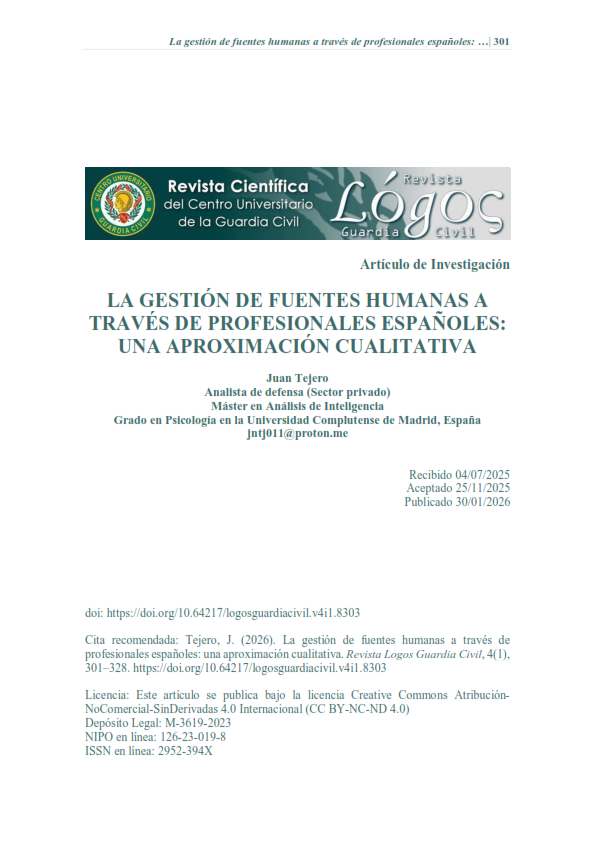
The management of human resources by Spanish professionals: a qualitative approach
DOI:
https://doi.org/10.64217/logosguardiacivil.v4i1.8303Keywords:
HUMINT, Human sources, psychology, motivations, expertsAbstract
This research examines the elements that impact human source management performance from the practical experience of Spanish professionals. Given the scarcity of Spanish studies on variables involved in human source management through expert analysis, qualitative expert content analysis is employed as an analytical technique to systematize the operational knowledge they provide. The study objectives seek to identify psychological factors that increase success in source management: motivations that facilitate or hinder information acquisition, effective techniques for establishing trust relationships, and quality indicators of these operational relationships, thereby addressing the proposed hypotheses. The findings, including that ideological or moral motivations constitute high-reliability factors, the importance of following effective operational guidelines while eliminating ineffective practices, and being guided by a structured operational system, among others, provide empirical foundation for refining approach strategies and developing HUMINT training doctrine.
Downloads
References
American Psychological Association. (n.d.). Operational psychology. https://www.apa.org/about/policy/operational-psychology.pdf
Braun, V., & Clarke, V. (2006). Using thematic analysis in psychology. Qualitative Research in Psychology, 3(2), 77–101. https://doi.org/10.1191/1478088706qp063oa
Braun, V., & Clarke, V. (2021). Thematic analysis: A practical guide. SAGE Publications.
Brod, G., Werkle-Bergner, M., & Shing, Y. L. (2013). The influence of prior knowledge on memory: A developmental cognitive neuroscience perspective. Frontiers in Behavioral Neuroscience, 7, 139. https://doi.org/10.3389/fnbeh.2013.00139
Charney, D. L., & Irvin, J. A. (2016). The psychology of espionage. Intelligencer: Journal of U.S. Intelligence Studies, 22, 71–77.
Fang, J. (2023). Application and limitations of the expectancy theory in organizations. Advances in Economics, Management and Political Sciences, 50, 130-134.
Goodman-Delahunty, J., & Howes, L. M. (2016). Social persuasion to develop rapport in high-stakes interviews: Qualitative analyses of Asian-Pacific practices. Policing and Society, 26(3), 270–290. https://doi.org/10.1080/10439463.2014.942848
Heuer, R. J. (1999). Psychology of intelligence analysis. Center for the Study of Intelligence.
Kitchenham, B., & Pfleeger, S. L. (2002). Principles of survey research part 5: Populations and samples. ACM SIGSOFT Software Engineering Notes, 27(5), 17–20.
Lim, W. M. (2025). What is qualitative research? An overview and guidelines. International Journal of Qualitative Methods, 24. https://doi.org/10.1177/14413582241264619
Moffett, L., Oxburgh, G. E., Dresser, P., Watson, S. J., & Gabbert, F. (2022). Inside the shadows: A survey of UK human source intelligence (HUMINT) practitioners, examining their considerations when handling a covert human intelligence source (CHIS). Psychiatry, Psychology and Law, 29(4), 487–505. https://doi.org/10.1080/13218719.2021.1926367
Naeem, M., Ozuem, W., Howell, K., & Ranfagni, S. (2023). A step-by-step process of thematic analysis to develop a conceptual model in qualitative research. International Journal of Qualitative Methods, 22. https://doi.org/10.1177/16094069231205789
Nunan, J., Stanier, I., Milne, R., Shawyer, A., & Walsh, D. (2020). Eliciting human intelligence: Police source handlers’ perceptions and experiences of rapport during covert human intelligence sources (CHIS) interactions. Psychiatry, Psychology and Law, 27(4), 511–537. https://doi.org/10.1080/13218719.2020.1734978
Pérez-Mena, D. E., y Sánchez, F. J. (2021). “Tienen que entrevistarlo ahorita porque lo van a matar”. Violencia policial e investigación cualitativa (Reflexiones desde el campo urbano en Caracas). Runa, 42(1), 139–157. https://doi.org/10.34096/runa.v42i1.8532
Redlich, A. D., Kelly, C. E., & Miller, J. C. (2014). The who, what, and why of human intelligence gathering: Self-reported measures of interrogation methods. Applied Cognitive Psychology, 28(6), 817–828. https://doi.org/10.1002/acp.3060
Rodríguez-Fandiño, J. C. (2022). Influencia del uso de tatuajes en la percepción de la retribución económica, una variable bajo el efecto Halo. Psicumex, 12, 1–21.
Staal, M. A., & DeVries, M. R. (2020). Military operational psychology. Psychological Services, 17(2), 195–198. https://doi.org/10.1037/ser0000308
Stanier, I., & Nunan, J. (2021, June 1). FIREPLACES and informant motivation. Centre for Research and Evidence on Security Threats (CREST). https://crestresearch.ac.uk/comment/fireplaces-and-informant-motivation/
Vroom, V. H. (1964). Work and motivation. Wiley.
Downloads
Published
How to Cite
Issue
Section
License
Copyright (c) 2026 Juan Tejero

This work is licensed under a Creative Commons Attribution-NonCommercial-NoDerivatives 4.0 International License.
-
Attribution — You must give appropriate credit, provide a link to the license, and indicate if changes were made. You may do so in any reasonable manner, but not in any way that suggests the licensor endorses you or your use.
-
NonCommercial — You may not use the material for commercial purposes.
-
NoDerivatives — If you remix, transform, or build upon the material, you may not distribute the modified material.
- No additional restrictions — You may not apply legal terms or technological measures that legally restrict others from doing anything the license permits.