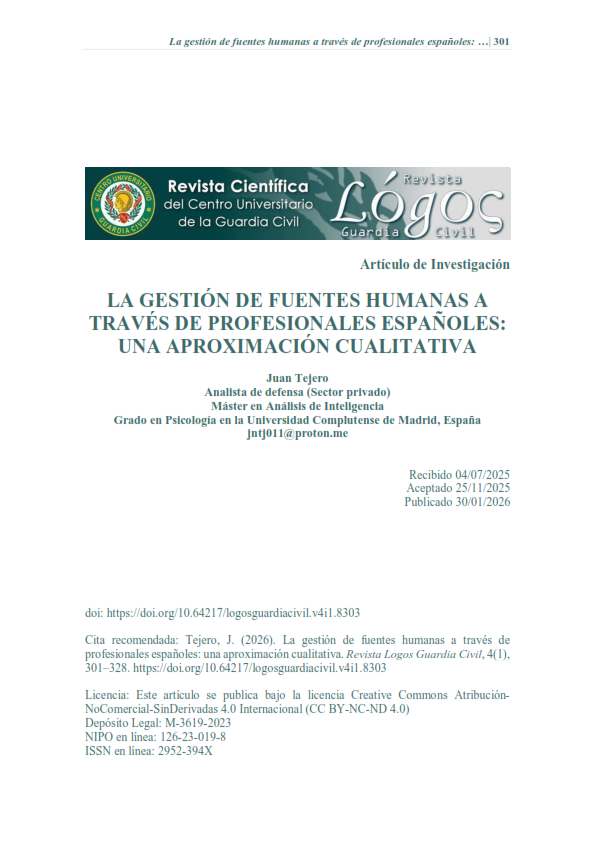
La gestión de fuentes humanas a través de profesionales españoles: una aproximación cualitativa
DOI :
https://doi.org/10.64217/logosguardiacivil.v4i1.8303Mots-clés :
HUMINT, Fuentes humanas, Psicología, Motivaciones, ExpertosRésumé
En esta investigación se analizan cuáles son algunos de los elementos que impactan en el desempeño de la gestión de fuentes humanas desde la experiencia práctica de profesionales españoles. Ante la escasez de estudios españoles sobre el estudio de variables implicadas en la gestión de dichas fuentes a través de expertos, se emplea la técnica analítica cualitativa de análisis de contenido de expertos para sistematizar los conocimientos operativos que aportan. Los objetivos del estudio buscan identificar factores psicológicos que incrementan el éxito en la gestión de fuentes: motivaciones que facilitan u obstaculizan la obtención de información, técnicas efectivas para establecer relaciones de confianza, e indicadores de calidad de estas relaciones operativas; y así responder las hipótesis planteadas. Los resultados, como el que las motivaciones ideológicas o morales son factores de alta confiabilidad, el seguir unas pautas de actuación efectiva y eliminar las ineficaces o estar guiado por un sistema de actuación, entre otros; proporcionan base empírica para refinar estrategias de aproximación y desarrollar doctrina de entrenamiento en HUMINT.
Téléchargements
Références
American Psychological Association. (n.d.). Operational psychology. https://www.apa.org/about/policy/operational-psychology.pdf
Braun, V., & Clarke, V. (2006). Using thematic analysis in psychology. Qualitative Research in Psychology, 3(2), 77–101. https://doi.org/10.1191/1478088706qp063oa
Braun, V., & Clarke, V. (2021). Thematic analysis: A practical guide. SAGE Publications.
Brod, G., Werkle-Bergner, M., & Shing, Y. L. (2013). The influence of prior knowledge on memory: A developmental cognitive neuroscience perspective. Frontiers in Behavioral Neuroscience, 7, 139. https://doi.org/10.3389/fnbeh.2013.00139
Charney, D. L., & Irvin, J. A. (2016). The psychology of espionage. Intelligencer: Journal of U.S. Intelligence Studies, 22, 71–77.
Fang, J. (2023). Application and limitations of the expectancy theory in organizations. Advances in Economics, Management and Political Sciences, 50, 130-134.
Goodman-Delahunty, J., & Howes, L. M. (2016). Social persuasion to develop rapport in high-stakes interviews: Qualitative analyses of Asian-Pacific practices. Policing and Society, 26(3), 270–290. https://doi.org/10.1080/10439463.2014.942848
Heuer, R. J. (1999). Psychology of intelligence analysis. Center for the Study of Intelligence.
Kitchenham, B., & Pfleeger, S. L. (2002). Principles of survey research part 5: Populations and samples. ACM SIGSOFT Software Engineering Notes, 27(5), 17–20.
Lim, W. M. (2025). What is qualitative research? An overview and guidelines. International Journal of Qualitative Methods, 24. https://doi.org/10.1177/14413582241264619
Moffett, L., Oxburgh, G. E., Dresser, P., Watson, S. J., & Gabbert, F. (2022). Inside the shadows: A survey of UK human source intelligence (HUMINT) practitioners, examining their considerations when handling a covert human intelligence source (CHIS). Psychiatry, Psychology and Law, 29(4), 487–505. https://doi.org/10.1080/13218719.2021.1926367
Naeem, M., Ozuem, W., Howell, K., & Ranfagni, S. (2023). A step-by-step process of thematic analysis to develop a conceptual model in qualitative research. International Journal of Qualitative Methods, 22. https://doi.org/10.1177/16094069231205789
Nunan, J., Stanier, I., Milne, R., Shawyer, A., & Walsh, D. (2020). Eliciting human intelligence: Police source handlers’ perceptions and experiences of rapport during covert human intelligence sources (CHIS) interactions. Psychiatry, Psychology and Law, 27(4), 511–537. https://doi.org/10.1080/13218719.2020.1734978
Pérez-Mena, D. E., y Sánchez, F. J. (2021). “Tienen que entrevistarlo ahorita porque lo van a matar”. Violencia policial e investigación cualitativa (Reflexiones desde el campo urbano en Caracas). Runa, 42(1), 139–157. https://doi.org/10.34096/runa.v42i1.8532
Redlich, A. D., Kelly, C. E., & Miller, J. C. (2014). The who, what, and why of human intelligence gathering: Self-reported measures of interrogation methods. Applied Cognitive Psychology, 28(6), 817–828. https://doi.org/10.1002/acp.3060
Rodríguez-Fandiño, J. C. (2022). Influencia del uso de tatuajes en la percepción de la retribución económica, una variable bajo el efecto Halo. Psicumex, 12, 1–21.
Staal, M. A., & DeVries, M. R. (2020). Military operational psychology. Psychological Services, 17(2), 195–198. https://doi.org/10.1037/ser0000308
Stanier, I., & Nunan, J. (2021, June 1). FIREPLACES and informant motivation. Centre for Research and Evidence on Security Threats (CREST). https://crestresearch.ac.uk/comment/fireplaces-and-informant-motivation/
Vroom, V. H. (1964). Work and motivation. Wiley.
Téléchargements
Publiée
Comment citer
Numéro
Rubrique
Licence
© Juan Tejero 2026

Ce travail est disponible sous licence Creative Commons Attribution - Pas d'Utilisation Commerciale - Pas de Modification 4.0 International.
-
Atribución — Usted debe dar crédito de manera adecuada, brindar un enlace a la licencia, e indicar si se han realizado cambios. Puede hacerlo en cualquier forma razonable, pero no de forma tal que sugiera que usted o su uso tienen el apoyo de la licenciante.
-
NoComercial — Usted no puede hacer uso del material con propósitos comerciales.
-
SinDerivadas — Si remezcla, transforma o crea a partir del material, no podrá distribuir el material modificado.
- No hay restricciones adicionales — No puede aplicar términos legales ni medidas tecnológicas que restrinjan legalmente a otras a hacer cualquier uso permitido por la licencia.