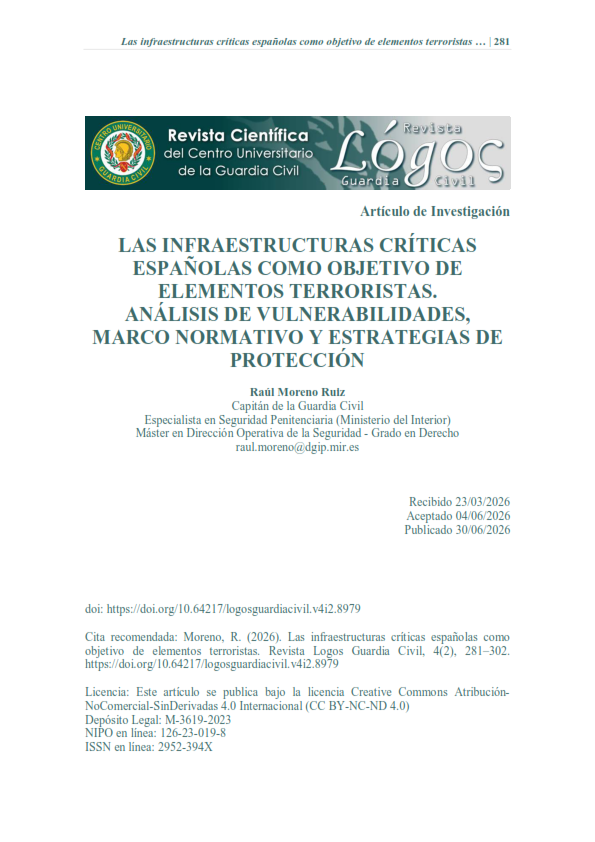
Spanish critical infrastructure as a target for terrorists. Analysis of vulnerabilities, regulatory framework and protection strategies
DOI:
https://doi.org/10.64217/logosguardiacivil.v4i2.8979Keywords:
critical infrastructure, terrorism, national security, cyberterrorism, hybrid threatAbstract
This article analyses the vulnerability of Spanish critical infrastructures to the terrorist threat from a legal, institutional and operational perspective. Its goals are to evaluate the current regulatory framework —led by Law 8/2011 and Directive (EU) 2022/2557 on the resilience of critical entities (CER)—, identify the strategic sectors most exposed to risk, and evaluate the institutional architecture of the Spanish protection system. Through documentary analysis and specialised literature review, it is concluded that Spain has a solid critical infrastructure protection (CIP) system. However, there are significant gaps in industrial cybersecurity, inter-administrative coordination and transposition of European directives that require urgent attention. The main threats identified for the 2025-2030 strategic horizon are jihadist terrorism, hostile state actors and cyberterrorism.
Downloads
References
Arteaga, F. (2023). Infraestructuras críticas y seguridad nacional en España. Real Instituto Elcano. https://www.realinstitutoelcano.org
Boin, A. y McConnell, A. (2007). Preparing for Critical Infrastructure Breakdowns: The Limits of Crisis Management and the Need for Resilience. Journal of Contingencies and Crisis Management, 15(1), 50-59. https://doi.org/10.1111/j.1468-5973.2007.00504.x
Clarke, R. A. y Knake, R. (2010). Cyber War: The Next Threat to National Security and What to Do About It. HarperCollins.
Departamento de Seguridad Nacional. (2021). Estrategia Nacional de Seguridad. Presidencia del Gobierno de España.
ENISA. (2024). ENISA Threat Landscape 2024. European Union Agency for Cybersecurity. https://www.enisa.europa.eu
Europol. (2023). European Union Terrorism Situation and Trend Report (TE-SAT) 2023. Publications Office of the European Union.
Europol. (2024). European Union Terrorism Situation and Trend Report (TE-SAT) 2024. Publications Office of the European Union. https://www.europol.europa.eu
Luiijf, E., Besseling, K. y De Graaf, P. (2013). Nineteen national cyber security strategies. International Journal of Critical Infrastructures, 9(1-2), 3-31. https://doi.org/10.1504/IJCIS.2013.052819
Masse, T. (2020). Terrorism and Critical Infrastructure: Assessing the Threat. Congressional Research Service.
Ministerio del Interior. (2023). Estrategia Nacional contra el Terrorismo (ENCOT) 2023. Secretaría de Estado de Seguridad. https://www.dsn.gob.es/es/publicaciones/estrategias-sectoriales/ENCOT2023
Moteff, J. D. (2014). Critical Infrastructures: Background, Policy, and Implementation. Congressional Research Service.
Reinares, F. (2014). Al-Qaeda y el 11-M en España. Revista de Occidente, 400, 75-95.
Reinares, F. y García-Calvo, C. (2022). Terrorismo yihadista en España: Características y tendencias. Real Instituto Elcano. https://www.realinstitutoelcano.org
Rinaldi, S. M., Peerenboom, J. P. y Kelly, T. K. (2001). Identifying, Understanding, and Analyzing Critical Infrastructure Interdependencies. IEEE Control Systems Magazine, 21(6), 11-25. https://doi.org/10.1109/37.969131
Weimann, G. (2015). Terrorism in Cyberspace: The Next Generation. Columbia University Press. https://doi.org/10.7312/weim16650
11. NORMATIVA
Naciones Unidas. Resolución 1373 (2001), de 28 de septiembre. Consejo de Seguridad de las Naciones Unidas. S/RES/1373 (2001).
Consejo de Europa. Convenio sobre Prevención del Terrorismo (CETS n.º 196). Varsovia, 16 de mayo de 2005. En vigor desde el 1 de junio de 2007.
Unión Europea. Directiva 2008/114/CE del Consejo, de 8 de diciembre de 2008, sobre la identificación y designación de infraestructuras críticas europeas. Diario Oficial de la Unión Europea, L 345, de 23 de diciembre de 2008.
España. Ley 8/2011, de 28 de abril, por la que se establecen medidas para la protección de las infraestructuras críticas. Boletín Oficial del Estado, núm. 102, de 29 de abril de 2011.
España. Real Decreto 704/2011, de 20 de mayo, por el que se aprueba el Reglamento de protección de las infraestructuras críticas. Boletín Oficial del Estado, núm. 121, de 21 de mayo de 2011.
España. Ley Orgánica 4/2015, de 30 de marzo, de Protección de la Seguridad Ciudadana. Boletín Oficial del Estado, núm. 77, de 31 de marzo de 2015.
Naciones Unidas. Resolución 2341 (2017), de 13 de febrero. Consejo de Seguridad de las Naciones Unidas. S/RES/2341 (2017).
España. Real Decreto 1150/2021, de 28 de diciembre, por el que se aprueba la Estrategia Nacional de Seguridad. Boletín Oficial del Estado, núm. 311, de 29 de diciembre de 2021.
España. Real Decreto 311/2022, de 3 de mayo, por el que se regula el Esquema Nacional de Seguridad. Boletín Oficial del Estado, núm. 105, de 4 de mayo de 2022.
Unión Europea. Directiva (UE) 2022/2555 del Parlamento Europeo y del Consejo, de 14 de diciembre de 2022, relativa a las medidas destinadas a garantizar un elevado nivel común de ciberseguridad en toda la Unión (Directiva NIS2). Diario Oficial de la Unión Europea, L 333, de 27 de diciembre de 2022.
Unión Europea. Directiva (UE) 2022/2557 del Parlamento Europeo y del Consejo, de 14 de diciembre de 2022, relativa a la resiliencia de las entidades críticas (Directiva CER). Diario Oficial de la Unión Europea, L 333, de 27 de diciembre de 2022.
Downloads
Published
How to Cite
Issue
Section
License
Copyright (c) 2026 RAUL MORENO RUIZ

This work is licensed under a Creative Commons Attribution-NonCommercial-NoDerivatives 4.0 International License.
-
Attribution — You must give appropriate credit, provide a link to the license, and indicate if changes were made. You may do so in any reasonable manner, but not in any way that suggests the licensor endorses you or your use.
-
NonCommercial — You may not use the material for commercial purposes.
-
NoDerivatives — If you remix, transform, or build upon the material, you may not distribute the modified material.
- No additional restrictions — You may not apply legal terms or technological measures that legally restrict others from doing anything the license permits.